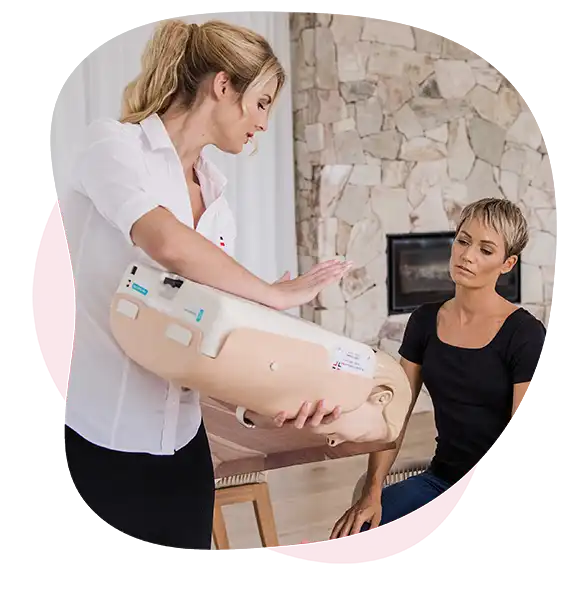
What is HLTAID009?
The HLTAID009 – Provide cardiopulmonary resuscitation (CPR) is a nationally accredited qualification that demonstrates your competence in providing emergency medical response. This credential, issued by Australia Wide First Aid (RTO 31961), is recognised across Australia by employers, training facilities, and healthcare providers as evidence that you have successfully completed formal training in life-saving techniques.
Why You Need This Credential
Employment Requirements: Many employers require staff to hold current first aid certification. Whether you work in healthcare, education, childcare, hospitality, construction, or office environments, having this credential demonstrates your commitment to workplace safety and duty of care.
Legal Compliance: Organisations must maintain trained personnel to meet Australian workplace health and safety regulations. By completing this course, you help your workplace meet its legal obligations and reduce liability.
Life-Saving Skills: In a medical emergency, immediate first aid response can be the difference between life and death. This credential ensures you have the knowledge and confidence to act decisively, perform CPR correctly, control bleeding, treat shock, and manage other critical situations until professional medical help arrives.
Career Advancement: First aid certification enhances your employability. Many roles in healthcare, security, hospitality, and education prioritise candidates with current credentials, opening doors to better opportunities and higher wages.
Peace of Mind: Whether in your workplace, home, or community, knowing you can respond appropriately to emergencies gives you confidence and peace of mind. Your skills could save a family member, colleague, or stranger.
Credential Validity
Credential validity period: P1Y. Industry standards and employer requirements may recommend earlier refresher training to maintain current best practices.
Recognition
Recognised by the Registered Training Organisation Australia Wide First Aid (RTO 31961), and accepted by employers and organisations across Australia. This is a nationally accredited statement of attainment, meeting AQF (Australian Qualifications Framework) standards.
Next Steps
- Book or view classes near you
- Download digital certificate from your student portal
- Contact support for verification requests
Upcoming HLTAID009 Classes Near You
| Location | Date | Time | Price | |
|---|---|---|---|---|
| Bankstown | Mon 12 Oct 2026 | 09:00–11:00 | $59.00 | Details |
| Blacktown | Mon 12 Oct 2026 | 09:00–11:00 | $59.00 | Details |
| Sydney CBD | Mon 12 Oct 2026 | 09:00–11:00 | $59.00 | Details |
| Tuggerah | Mon 12 Oct 2026 | 09:00–11:00 | $59.00 | Details |
| Blacktown | Mon 12 Oct 2026 | 14:00–15:00 | $59.00 | Details |
| Campbelltown | Tue 13 Oct 2026 | 09:00–11:00 | $65.00 | Details |
What You'll Learn
Upon successful completion of this credential, you will be able to demonstrate the following competencies:
- ✓ Assess Emergency Situations: Quickly evaluate the scene, identify hazards, and determine if CPR is needed.
- ✓ Perform Cardiopulmonary Resuscitation (CPR): Execute correct chest compression and rescue breathing techniques using current Australian Resuscitation Council guidelines.
- ✓ Use Automated External Defibrillators (AEDs): Operate AED equipment safely and effectively in cardiac emergencies.
- ✓ Manage Choking: Recognize signs of choking and apply appropriate clearing techniques.
- ✓ Recovery Position: Place an unconscious breathing patient in the recovery position to maintain airway patency.
- ✓ Communicate with Emergency Services: Effectively communicate patient information and relay critical details to paramedics.
- ✓ Follow Infection Control Practices: Implement universal precautions and hygiene protocols to protect yourself and others.
- ✓ Maintain Professionalism: Understand legal obligations, duty of care, and ethical responsibilities in providing CPR assistance.
Key Benefits
- ✓ Industry-recognised certification
- ✓ Practical, hands-on training
- ✓ Same-day certificate issued
- ✓ Valid for P1Y
- ✓ Expert instruction
- ✓ Confidence in emergencies
How HLTAID009 Compares
Choosing the right first aid credential depends on your industry, role, and specific needs. Here's how HLTAID009 compares to other available credentials:
| Feature | HLTAID009 | HLTAID011 | HLTAID012 |
|---|---|---|---|
| Focus Area | CPR & Cardiac Emergencies | General First Aid | Childcare First Aid |
| Validity Period | 12 months | 3 years | 3 years |
| CPR Training | Comprehensive | Included | Adult + Pediatric |
| General First Aid | Not included | Comprehensive | Yes |
| Pediatric Focus | No | No | Yes - Specialized |
| Scope | Narrow & Specialized | Broad & Versatile | Childcare/Education |
| Best For | Healthcare, Events | General Workplace | Childcare, Schools |
Choose HLTAID009 if: You need focused CPR training with regular renewal requirements.
HLTAID009 – Elements and performance criteria
These outline the core tasks and expected outcomes for HLTAID009. Each element describes what must be achieved, and the associated performance criteria describe how success is demonstrated during training and assessment.
What are the elements in HLTAID009 Provide CPR?
HLTAID009 Provide CPR includes four elements:
- Respond to an emergency situation
- Perform CPR procedures to ARC guidelines
- Communicate incident details
- Review the incident
How do I recognise and assess an emergency (1.1)?
Apply DRSABCD:
- Danger – check the scene
- Response – talk/touch
- Send for help (000)
- Airway – open/clear
- Breathing – look, listen, feel
- CPR or Defibrillate as needed
How do I ensure safety for self, bystanders and the casualty (1.2)?
Control hazards, use PPE, keep bystanders back and avoid moving the casualty unless there is immediate danger (traffic, fire, electricity).
How do I assess for the need for CPR (1.3)?
If unresponsive and not breathing normally (agonal gasps are not normal), begin CPR immediately and attach an AED when available.
When should I call emergency services (1.4)?
Dial 000 early, use speakerphone, provide exact location/landmarks and follow dispatcher instructions (consider the Emergency+ app).
What is the correct CPR technique to ARC guidelines (2.1)?
CPR per ARC:
- Rate: 100–120/min
- Ratio: 30:2 compressions to breaths
- Depth: one-third of chest (adults ~5–6 cm)
- Minimise interruptions; allow full recoil
Where do I place my hands for adult chest compressions?
Place the heel of your hand on the centre of the chest (lower half of the sternum), interlock hands, keep arms straight and press vertically.
What if I can’t give breaths during CPR?
If breaths are not possible, give compression-only CPR at 100–120/min until an AED or help arrives.
How do I use an AED correctly (2.3)?
Turn on the AED, follow voice prompts, attach pads to a bare chest, ensure no contact during analysis/shock and resume CPR immediately.
How do I show respectful behaviour toward a casualty (2.2)?
Be respectful: introduce yourself, explain actions, protect privacy/dignity and communicate calmly.
How do I minimise interruptions during CPR?
Keep pauses as short as possible, switch rescuers about every 2 minutes and resume compressions promptly after shocks or ventilations.
When should CPR be stopped?
Cease CPR if the casualty shows signs of life, you are relieved, the scene is unsafe or you are exhausted.
What infection control should I use during CPR?
Apply standard precautions: gloves, a barrier device for breaths, hand hygiene and safe disposal of contaminated items.
What is the chain of survival and why is it important?
The chain of survival is: early recognition/call for help, early CPR, early defibrillation and advanced care—improving survival outcomes.
What details should I provide to emergency services (3.1)?
Provide: location, number of casualties, condition, CPR/AED provided, hazards and access directions.
How do I report an incident at work (3.2)?
Follow workplace incident procedures, notify supervisors and document per policy and legislation.
How do I maintain privacy and confidentiality (3.3)?
Share on a need-to-know basis with authorised responders and store records securely per organisational policies.
How do I recognise and manage psychological impacts after CPR (4.1)?
Watch for stress (sleep, mood, anxiety). Access EAP, your GP or counselling if needed.
How do I contribute to an incident review (4.2)?
Join debriefs, give constructive feedback and document lessons learned to improve training, procedures and equipment.
How do I recognise unconsciousness and abnormal breathing?
Check response, open the airway and look, listen, feel for normal breathing. Agonal gasps are not normal—start CPR.
What are common AED pad placements for adults and children?
Adults: pad on right upper chest and left lateral chest. Children/small bodies: consider front–back placement and use paediatric pads if available.
How often should rescuers rotate during CPR?
Rotate rescuers about every 2 minutes (or at AED analysis) to maintain quality compressions and reduce fatigue.
What should I do if the casualty starts breathing again?
If breathing resumes, stop compressions, place in the recovery position, monitor airway/breathing and be ready to resume CPR if required.
What documentation is commonly required after CPR?
Complete an incident report: record times, observations, CPR/AED interventions and outcomes. Store securely per policy.
How do I prepare for fast AED access at work?
Know AED locations, check readiness, train staff, ensure clear signage and unobstructed access routes.
HLTAID009 – Assessment requirements
Assessment requirements for HLTAID009 include performance evidence, knowledge evidence and assessment conditions. These requirements align with Australian Resuscitation Council (ARC) guidelines and other national peak clinical bodies, as well as State/Territory regulations and workplace procedures.
Performance evidence
Evidence of the ability to complete tasks outlined in the elements and performance criteria for HLTAID009 in realistic workplace or community settings. Candidates must demonstrate practical skills in accordance with State/Territory regulations, first aid codes of practice, ARC guidelines, national peak clinical bodies and workplace/site procedures.
What practical skills are assessed in HLTAID009 Provide CPR?
You will demonstrate ARC-aligned CPR on adult and infant manikins, recovery positioning for an unconscious breathing casualty, AED operation, rescuer rotation with minimal interruptions, safe response to vomiting/regurgitation, accurate verbal handover to emergency services and a post-incident review.
How do I manage an unconscious breathing casualty?
Use the recovery position to reduce airway compromise, monitor breathing, manage hazards and call 000, following ARC guidance and site procedures.
What adult CPR performance is required?
Complete ≥ 2 minutes of single-rescuer CPR (5 cycles at 30:2) on an adult manikin on the floor, meeting ARC rate, depth, recoil and minimal-pause criteria.
Do I need to deliver an AED shock during assessment?
Yes. Follow AED voice prompts, deliver ≥ 1 shock safely with stand-clear checks, then resume compressions immediately.
How do we rotate rescuers with minimal interruptions?
Rotate rescuers about every 2 minutes at a natural break (e.g., AED analysis). Keep pauses as short as possible and resume compressions promptly.
What should I do if the casualty vomits during CPR?
If vomiting occurs, turn to protect the airway, clear the mouth, re-open the airway and resume CPR immediately, maintaining safety.
Why must the adult manikin be on the floor?
A firm surface (the floor) allows adequate compression depth and recoil, which is essential for ARC-compliant CPR.
What infant CPR performance is required?
Complete ≥ 2 minutes of single-rescuer infant CPR (5 cycles) on a firm surface, using ARC age-appropriate technique, depth and ventilation volumes.
How do I manage an unconscious non-breathing adult?
Begin CPR immediately, attach the AED early, follow prompts, deliver a shock if advised and keep interruptions to a minimum.
How do I manage an unconscious non-breathing infant?
Provide infant CPR on a firm surface, using correct rate, depth and effective ventilations per ARC, until help arrives or signs of life return.
What details must I hand over to emergency services?
Share: location, timeline, initial condition, CPR/AED actions, changes during care and hazards. Follow dispatcher or paramedic prompts.
How do I give an accurate verbal report after CPR?
Use a structured handover: who the casualty is, what occurred, when events happened, treatments given, response and current status.
What is expected in the incident review?
Conduct a brief review: note positives, identify improvements (equipment, training, process) and consider wellbeing support for rescuers.
How do State/Territory regulations and ARC guidelines affect assessment?
Tasks are performed to ARC guidelines, State/Territory codes of practice and workplace/site procedures to ensure safe, compliant CPR.
When should CPR be stopped during assessment?
Cease CPR on signs of life, when professionals take over, the scene is unsafe or you are exhausted.
What safety checks are required before delivering an AED shock?
Announce stand clear, confirm no contact, check the area is safe, and press shock only when the AED instructs.
Knowledge evidence
Demonstrated knowledge required to complete the tasks outlined in the elements and performance criteria for HLTAID009. This typically includes current first aid principles, legal and ethical considerations, risk minimisation, infection control and context-specific factors relevant to the unit.
What knowledge does HLTAID009 Provide CPR cover?
HLTAID009 Provide CPR covers: ARC-aligned CPR skills, hazard/risk control, infection control with barrier devices, legal/workplace responsibilities, AED operation and emergency communication for adults, children and infants.
Which ARC guidelines apply to HLTAID009?
ARC guidelines direct recognition of cardiac arrest, CPR rate/ratio/depth, recovery position, choking care and AED use for evidence-based resuscitation.
How do I manage hazards and minimise risk before CPR?
Perform a scene survey, identify dangers (traffic, electricity, sharps, aggression, environment), apply controls and approach only when safe.
What infection control procedures are required for CPR?
Use standard precautions – hand hygiene, gloves and a barrier device for ventilations; clean and dispose per workplace procedures.
How do I keep my CPR knowledge current?
Maintain currency by refreshing CPR annually, practicing regularly and following ARC updates and workplace drills.
What are first aid codes of practice?
First aid codes of practice set practical guidance for training, kits, facilities and procedures to meet workplace obligations.
Which workplace procedures are relevant to CPR delivery?
Follow emergency plans, incident reporting, PPE/infection control, AED location/readiness and handover processes.
What is my duty of care when providing CPR?
Duty of care means acting reasonably within your training, prioritising safety and providing timely assistance without negligence.
Why must I know my own skills and limitations?
Working within your scope reduces risk; call early for help and use available resources when advanced care is needed.
How does consent apply to CPR?
Obtain consent from conscious adults; for unconscious casualties, consent is implied.
What are my privacy and confidentiality obligations?
Share on a need-to-know basis with authorised responders and store records securely per policy and law.
How can rescuers manage stress after an incident?
Use debriefs, peer support and EAP, practice self-care and seek professional support if symptoms persist.
How does airway position affect breathing during CPR?
Optimise airway with head-tilt chin-lift (adults/children) and a neutral head position for infants to maintain patency.
When should CPR be ceased?
Cease CPR on signs of life, when professionals take over, the scene is unsafe or you are exhausted.
What is the correct use of an AED in CPR?
Turn on the AED, follow prompts, attach pads to a bare chest, ensure no contact during analysis/shock and resume CPR immediately.
How do I maintain AED safety and readiness?
Check pad/battery expiry, run self-tests per manufacturer and keep the AED accessible with clear signage.
What is the chain of survival?
The chain of survival: early recognition/call, early CPR, early defibrillation and advanced care.
How do I access emergency services quickly?
Call 000, use speakerphone, give precise location/landmarks and follow instructions (consider Emergency+ app).
How do I recognise unconsciousness and abnormal breathing?
Check response, open the airway and look, listen and feel. Agonal gasps are not normal—start CPR.
What are the CPR rate, ratio and depth targets?
Rate 100–120/min, ratio 30:2, depth one-third of the chest (adults ~5–6 cm; children ~5 cm; infants ~4 cm).
Where should hands be placed for compressions?
Compress the centre of the chest on the lower half of the sternum; two hands (adults), one/two hands (children), two fingers (infants).
What anatomy and physiology differences affect CPR by age?
Age-related differences in airway, chest compliance and lung volumes require adjusted hand position, depth and ventilation volumes.
When is compression-only CPR appropriate?
If breaths are not possible, provide compression-only CPR at 100–120/min until an AED or help arrives.
What PPE and barrier devices should I use for CPR?
Use gloves and a resuscitation barrier device for ventilations; add eye protection and a mask per risk assessment.
Assessment conditions
Each candidate must demonstrate skills in an environment that provides realistic, in‑depth scenarios and simulations to assess practical skills and decision‑making.
Due to the nature of first aid training, it is acceptable for performance evidence to be collected in a simulated environment, provided that conditions reflect real‑world constraints, resources and timeframes.
What is the HLTAID009 assessment environment like?
You will be assessed in realistic, in‑depth scenarios that simulate workplace/community emergencies, with relevant equipment and resources set up to mirror real conditions.
Is simulated assessment acceptable for HLTAID009?
Yes. It is acceptable for performance evidence to be collected in a simulated environment that faithfully represents real‑life conditions.
Do I need to perform CPR on manikins for assessment?
Yes. You will demonstrate compressions and ventilations on resuscitation manikins following ARC guidelines.
Will I practice on both adult and infant manikins?
Yes. You will use adult and infant manikins to demonstrate age‑appropriate CPR techniques per ARC.
Do I use an AED training device during assessment?
Yes. You will use an AED training device, follow prompts and integrate it safely into your CPR sequence.
Is PPE required during HLTAID009 assessment?
Yes. PPE is required and provided to support safe, realistic assessment conditions and standard precautions.
What equipment will be available during assessment?
Assessment provides adult/infant manikins, an AED training device and PPE, aligned to ARC guidance and workplace expectations.
How realistic are the simulated CPR scenarios?
Scenarios simulate real‑life events, including relevant equipment, hazards and workplace/community resource constraints.
What CPR skills must I demonstrate to ARC standards?
Demonstrate ARC standards for rate, depth, recoil, 30:2 ratio, minimal interruptions and effective ventilations on the correct manikin.
Do I need to position an unconscious breathing casualty?
Yes. Manage an unconscious, breathing casualty using positioning (e.g., recovery position) to reduce airway compromise in line with ARC.
How is an unconscious non‑breathing adult assessed?
Perform ≥ 2 minutes of single‑rescuer CPR on an adult manikin on the floor, integrate AED prompts/shock safely and keep interruptions minimal.
How is an unconscious non‑breathing infant assessed?
Perform ≥ 2 minutes of single‑rescuer infant CPR on a firm surface, using age‑appropriate ARC technique.
Is verbal reporting part of the assessment?
Yes. Provide an accurate verbal report and handover to emergency services as part of your assessment.
Do I need to review the incident after assessment scenarios?
Yes. Complete a brief post‑incident review to reflect on performance and identify improvements.
Who can assess HLTAID009?
Assessors must satisfy the Standards for Registered Training Organisations and hold this unit or demonstrate equivalent skills/knowledge.
Why must adult CPR be performed on the floor?
A firm surface (the floor) enables adequate compression depth/recoil for ARC‑quality CPR.
What AED practices are checked during assessment?
Assessed AED practices: pad placement, stand‑clear checks, following prompts, delivering a shock when advised and immediate CPR resumption.
Is the assessment aligned to ARC and codes of practice?
Yes. Tasks align with ARC guidelines, first aid codes of practice and site procedures for compliant, real‑world practice.
Real Student Reviews
What our students say about their first aid training experience


Liya Varghese
via trustpilot
Hi, I'm Liya Varghese. Yesterday, I attended the class and it was amazing! The teacher is very cool and has a very positive attitude. I was a bit worried about how to do things, but she explained everything in great detail. I really appreciated her way of teaching. Overall it was a great learning experience.


Geoff Keogh
via trustpilot
Instructor was very professional clearly explains every aspect. Made everyone feel confident to carry out the assessments. felt we gained a good understanding of approach if we come in front of first aid situation
WEBBY
via trustpilot
Instructor stephen delivered training base on real life scenario and straight forward for firstaid treatment. Stephen was accomodoting to all questioned raised and answered based on his knowledged and experienced on real event.
Larissa Macleod
via trustpilot
Was really informative! Learned many things I’ve never been taught in the years I have done First aid and CPR training. Highly recommend! Ron is very knowledgeable given his past experiences and his upkeep on everything.
Tiri Marsters
via trustpilot
Tutor very thorough Delivered content well Those doing it wrong had to do the practical again She is the best one yet

Jacinta B
via productreview
John was great and will definitely be refreshing my course with him. He had so much patience and explained everything clearly.

Nicole Coubrough
via productreview
The trainer was great I really learnt a lot enjoyed the course

lincolnedwards2006
via productreview
Amazing training and atmosphere. The teaching was well paced and meticulous

Danielle S.
via productreview
I completed a first aid course less than 2 years ago with a different company and took absolutely nothing away from it. I did not feel capable of any basic first aid. Fast forward to today's session with Australia Wide and I actually feel confident to use the skills I learnt today. The course was great and a big part of that was due to Quintin and the way he delivered the information. Thankyou!!!!

Cathryn C
via productreview
The course was informative and practical, as well as intensive and detailed. It was a comfortable environment and questions were answered in a clear and understandable way.

Woggaloon
via google
Great company, Anthony the instructor was was very professional, did not complicate the course he was awesome.I would use them again. Thank you Anthony

Kirsteen Miller
via google
Jeanie was very professional and I got a high standard of training

Sharon Mann
via google
Anthony was by far the best instructor I have had by far .

Imogen Flanagan
via google
Very thorough if occasionally a bit rushed - our teacher Di was excellent in showing me some alternatives for CPR and first aid to help with my shaky hands and weak wrists, and made me feel much for confident in being able to help should the time come ❤️

Tammy Pope
via google
Jeanie was an awesome trainer and assessor. Hands down the best I have encounter in all the years of doing first aid training of any sort.